
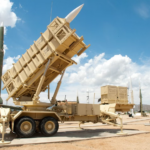
Protecting Missiles From EMI: Real-World Rocket Science
March 17, 2026Jammed, spoofed,
and silenced.
How modern threats are targeting missiles and drone swarms, and why shielding is the answer.
FIG. 01Both a guided missile and a 300-drone swarm depend on uninterrupted signal integrity.
Key figures
in this article
$1.1B
$2,300
80–100 dB
10 MHz – 10 GHz
A few mm
The battlefield has gone electromagnetic. Whether it’s a precision-guided missile closing on a target 40 miles away or a 300-drone swarm executing a coordinated strike, both depend on one thing above all else: uninterrupted signal integrity. Adversaries know it.
Electronic warfare, specifically signal jamming and GPS spoofing, has emerged as one of the most cost-effective and strategically devastating tools in modern conflict. The response from defense engineers isn’t just better software or stronger transmitters. Increasingly, it starts at the physical layer: the gaskets, seals, and shielding that protect every vulnerable seam and joint in a weapon system’s housing.
This article examines how jamming threatens guided missiles and drone swarms, what attackers are doing to exploit electronic vulnerabilities, and how EMI/RFI shielding, including the conductive elastomer gaskets PNA produces, forms a critical and often underappreciated line of defense.
What’s really at stake.
Electromagnetic interference in warfare isn’t new. But the scale, precision, and accessibility of jamming technology in 2026 is a qualitative leap from Cold War–era electronic warfare. Adversaries no longer need sophisticated platforms to deny GPS or disrupt datalinks. Commercial and semi-commercial jammers have proliferated, and state actors have invested heavily in electronic attack systems that operate across multiple frequencies at once.
How jamming attacks work
At its core, jamming is the intentional transmission of noise or competing signals on the frequency a target system is using. There are four main categories.
GPS / GNSS jamming
Overwhelms the weak GPS signal with noise, so guided munitions and drones lose positional awareness. Even short interruptions can cause catastrophic trajectory errors in a fast-moving missile.
Communications jamming
Severs the datalink between a swarm and its operator, or between networked assets, effectively blinding command and control.
Radar jamming
Floods a seeker head with noise or false returns, so a missile loses target lock or pursues a ghost.
Spoofing
Rather than brute-force noise, injects false signals that mimic legitimate GPS or sensor data. The system navigates to the wrong location while “believing” it is on course.
Real-world impact
In multiple recent conflicts, drone swarms have been neutralized not by kinetic intercepts but by jamming their control frequencies. GPS-guided munitions have been redirected miles off target through coordinated spoofing. These are no longer theoretical scenarios. They are documented battlefield outcomes.
Every seam is an antenna.
A precision-guided missile is an extraordinarily complex electronic system compressed into a small, high-speed airframe. The guidance computer, seeker head, fuzing electronics, and datalink receiver all operate in close proximity, generating their own emissions while being bombarded by external fields: radar, jammers, and the target’s own emissions.
FIG. 02Joints, access panels, connectors, and cable penetrations are all potential paths for unwanted energy.
The physical construction of a missile creates natural EMI vulnerabilities. Every joint, access panel, connector, and cable penetration is a potential antenna. At the frequencies modern jammers use, even a gap of a few millimeters can let significant energy leak into a guidance compartment.
This is where conductive EMI gaskets play a structural role. Placed at every seam in the housing, they maintain electrical continuity across the airframe, completing the Faraday cage that keeps jamming signals out of the electronics bay. PNA converts particle-filled conductive elastomers, typically silver-plated aluminum or nickel-graphite in silicone or fluorosilicone, that seal these joints while withstanding the thermal and mechanical stress of high-speed flight.
Scale makes vulnerability exponential.
A single drone is a relatively simple electronic system. A coordinated swarm of 50, 200, or 1,000 drones introduces a mesh of radio signals, inter-drone links, GPS receivers, and control channels that creates an enormous electromagnetic attack surface.
How swarms are jammed
Centralized control links
A ground station or manned aircraft commands the swarm over a datalink. Jam the uplink and the entire swarm may go dark or revert to pre-programmed fallback behaviors, which adversaries can anticipate.
GPS-based coordination
Each drone uses GPS to hold its position in formation. Jam or spoof GPS and spatial coherence breaks down: collisions, erratic behavior, dispersal.
Inter-drone mesh
Advanced swarms use peer-to-peer radio links. Harder to jam comprehensively, but still vulnerable to wideband noise or targeted frequency attacks.
The Department of War’s Drone Dominance Program, a $1.1 billion initiative to field hundreds of thousands of low-cost UAS by 2027, explicitly recognizes this vulnerability. Every drone in the program must meet enclosure-level EMI shielding requirements. The challenge is delivering that shielding at scale, on units priced as low as $2,300.
The cost-asymmetry challenge
A $5,000 attack drone is cheap enough to field by the thousand. But if a $200 jammer can defeat it, the economics favor the jammer overwhelmingly. The engineering response must be equally cost-conscious: shielding for low-cost drones cannot add hundreds of dollars per unit.
That has driven demand for efficient, manufacturable solutions (die-cut conductive gaskets, form-in-place elastomers, precision-cut seals) that integrate into high-volume lines without specialized assembly. It’s exactly the rapid-prototyping, custom-cut capability PNA brings to drone manufacturers working under the DoW’s accelerated acquisition model.
A multi-layer defense.
No single measure stops a determined jammer. Effective protection is built in layers, from the outer housing down to the circuit board, and each layer depends on the integrity of the one outside it.
Guidance · fuzing · datalink
Enclosure
The outer housing acts as a first-order Faraday cage. Metallic housings provide baseline attenuation; composite and plastic bodies, increasingly common to cut weight and radar cross-section, rely on conductive coatings or embedded mesh. A Faraday cage is only as effective as its weakest gap: a housing with 100 dB of attenuation across its main body can be compromised to near zero by a single unshielded seam.
Gaskets & seals at every interface
Conductive elastomer gaskets fill the gaps at every joint (hatches, battery doors, connector panels, airframe segments) and seal against moisture, dust, and fuel vapor, which is critical for maritime and all-weather UAS. Military specifications commonly demand 80 to 100 dB of suppression from 10 MHz to 10 GHz.
Cable & connector shielding
Inside the airframe, cables act as unintended antennas, picking up jamming signals and conducting them into sensitive circuits. EMI filter inserts at connectors, ferrite beads, and braided shielding block conducted interference through the harness.
Board-level filtering
Some interference will still reach the circuit boards. On-board EMI filters, decoupling capacitors, and shielded compartments are the final layer, protecting the signals guidance algorithms and fuzing computers depend on.
Material selection at the seam
Material choice matters enormously at layer two. Nickel-graphite has become a practical alternative given the roughly 200% surge in silver prices seen in early 2026.
Silver-plated aluminum
Highest conductivity
Nickel-graphite
Cost-effective where silver is prohibitive
Fluorosilicone binder
Chemical resistance in fuel-wetted zones
Governed, not guessed.
Shielding in defense systems isn’t speculative engineering. A rigorous framework of military standards defines how much protection is required and how it must be verified.
MIL-STD-461G
Subsystem
Conducted and radiated emission and susceptibility limits. A guidance computer must neither generate interference nor succumb to specified external levels.
MIL-STD-464D
Platform
Electromagnetic environmental effects (E3) survivability for the whole missile or UAS, including HIRF, lightning, and EMP.
MIL-DTL-83528
Material
Material and performance requirements for conductive elastomer gaskets: shielding effectiveness, compression set, environmental durability.
Compliance isn’t optional; it’s a contract requirement. It drives procurement toward suppliers with documented material traceability, ISO 9001 manufacturing controls, and consistent, repeatable shielding performance at scale. PNA holds ISO 9001:2015 registration and ITAR compliance and manufactures domestically, qualifications that matter more as defense supply chains face country-of-origin scrutiny.
Where electronic warfare is headed.
Cognitive EW systems can now scan the spectrum, identify a target’s operating frequencies, and adapt their jamming waveform in near real time. Anti-drone systems use AI to identify and jam communication protocols autonomously. GPS-denied navigation, once a lab concept, is becoming a procurement requirement.
The engineering response runs in parallel: anti-jam GPS receivers with controlled radiation pattern antennas, inertial navigation that holds precision through extended GPS outages, and frequency-hopping, spread-spectrum datalinks.
But every one of these countermeasures shares a dependency. A frequency-hopping radio still needs a shielded enclosure. An anti-jam GPS receiver still needs a gasketed housing to keep conducted interference from overwhelming its front end.
The physics of electromagnetic interference doesn’t change as adversaries get smarter.
What this means for defense manufacturers.
For engineers and procurement teams on guided munitions and UAS programs, the implications are direct.
Design shielding in, not on.
Retrofitting EMI gaskets to a housing that wasn’t designed for them is expensive and often ineffective. Enclosure geometry, seam design, and material selection should account for shielding from the earliest design stages.
Material qualification takes time.
Conductive elastomers must be tested and qualified to MIL-DTL-83528. The process rewards early engagement with suppliers who have documented traceability and existing test data.
Cost and performance can be balanced.
Choosing between silver-plated aluminum, nickel-graphite, and other fillers lets program managers optimize for performance, cost, and galvanic compatibility with the host structure.
Domestic supply chains matter.
With ITAR requirements and growing congressional scrutiny of foreign-sourced components, US-based manufacturers with documented compliance programs reduce program risk.
The parts that
close the seam.
The shielding products discussed in this article, converted to your print on our Jamaica, NY floor.
EMI / RFI Gaskets
Conductive elastomer gaskets and shielding die-cuts converted to print for enclosure and LRU joints.
Conductive O-Rings
Silver- and nickel-graphite filled O-rings for continuous ground paths in sealed connector interfaces.
Flange Gaskets
Conductive elastomer mounting-flange gaskets for connectors, waveguides, and enclosure interfaces.
Shielding for your program.
Designed in from the start.
We work directly with primes and sub-tier manufacturers to specify, prototype, and supply EMI/RFI gaskets and conductive elastomer seals for missile, UAS, and naval programs. Short lead times, in-stock materials, custom-cut.
718.412.0468 · Quotes in 24 hours